Poverty
The Running ManPoverty is a governing condition rather than a private misfortune. It reaches from the Richards family’s cold, medically precarious apartment to the abandoned districts south of the Canal, and from unemployment benefits measured in oldbucks to the billion-New-Dollar spectacle offered by the Games. The poor are not simply deprived of comfort: their access to medicine, transport, work, clean air, safety, and meaningful consent is narrowed until institutional coercion can present itself as opportunity.
Material Life and Medical Precarity
For the Richards family, poverty is first experienced through the body. Cathy has the flu, and the household cannot secure the care Ben Richards considers necessary. He rejects the prospect of relying on a block midwife with dirty hands and whiskey breath, insisting that his daughter needs a real doctor and modern equipment. His anger is directed not at parental failure but at the humiliating alternatives poverty supplies: either accept inadequate treatment or depend on public assistance as the head of a fatherless house. Sheila Richards refuses that money because she understands it as a bounty placed on her husband, not as dignified support. Her refusal exposes the moral violence hidden inside the benefit system: aid arrives attached to the social degradation of the family and to the expectation that the state may profit from Ben’s disappearance.
The family’s desperation is also registered in food. During the Games selection process, Ben eats a cafeteria meal consisting of cornflakes, greasy home fries, scrambled eggs, hard toast, milk, muddy coffee, sugar, salt, and fake butter. He devours it because it is his first real food in an unknown length of time beyond greasy pizza wedges and government pill-commodities, yet the meal tastes emptied of pleasure, reduced to brute nutrients. The sight of food triggers the thought of help pills and fake milk for the baby, followed by uncertainty about when money might begin to arrive. Poverty therefore interrupts even the promise of the Games: the possibility of income is experienced first as a doubtful promotional device rather than a secure future.
Unemployment and Constrained Choice
Ben’s poverty is inseparable from his labor history. After years of searching, he had found a hundred miserable day and half-day jobs, including work cleaning jellylike slime from beneath piers and in sump ditches while others merely claimed to be looking for employment. Eventually even these jobs disappeared. One evening, after another fruitless day, a wealthy drunk offered him ten New Dollars to pull down his pants so the man could inspect whether street freaks really had enormous genitals. Ben knocked him down and ran. The incident shows how unemployment converts economic need into vulnerability to sexual humiliation, while also marking the point at which endurance gives way to physical refusal.
By the time Ben walks toward the Games Building, his weekly twenty-dollar unemployment allotment in oldbucks has already been spent. He cannot afford a token for the pneumo bus and must walk three miles through the rain, passing stripped vehicles, deserted shops, garbage, rats, and cycle gangs. His poverty is visible enough for the roving packs to sense it, yet he is not attacked, as though deprivation itself has become a recognizable social category. The city’s economy has not merely failed to employ him; it has made poverty legible as a condition that governs movement, exposure, and risk.
The Games convert this constrained condition into nominal consent. Dan Killian explains that a contestant receives one hundred New Dollars for every hour he remains free, forty-eight hundred dollars in running money, a twelve-hour head start, and a billion New Dollars if he lasts thirty days. The unspent balance is refundable to the surviving family if he falls before forty-eight hours. The scale of the offer explains why participation can appear voluntary while remaining structurally coercive: a family denied ordinary medical security and reliable wages is invited to stake a life against the probability of being hunted. Ben’s laughter at the promise of the grand prize recognizes the gap between the language of opportunity and the material reality that makes the choice unavoidable.
Segregated Urban Space
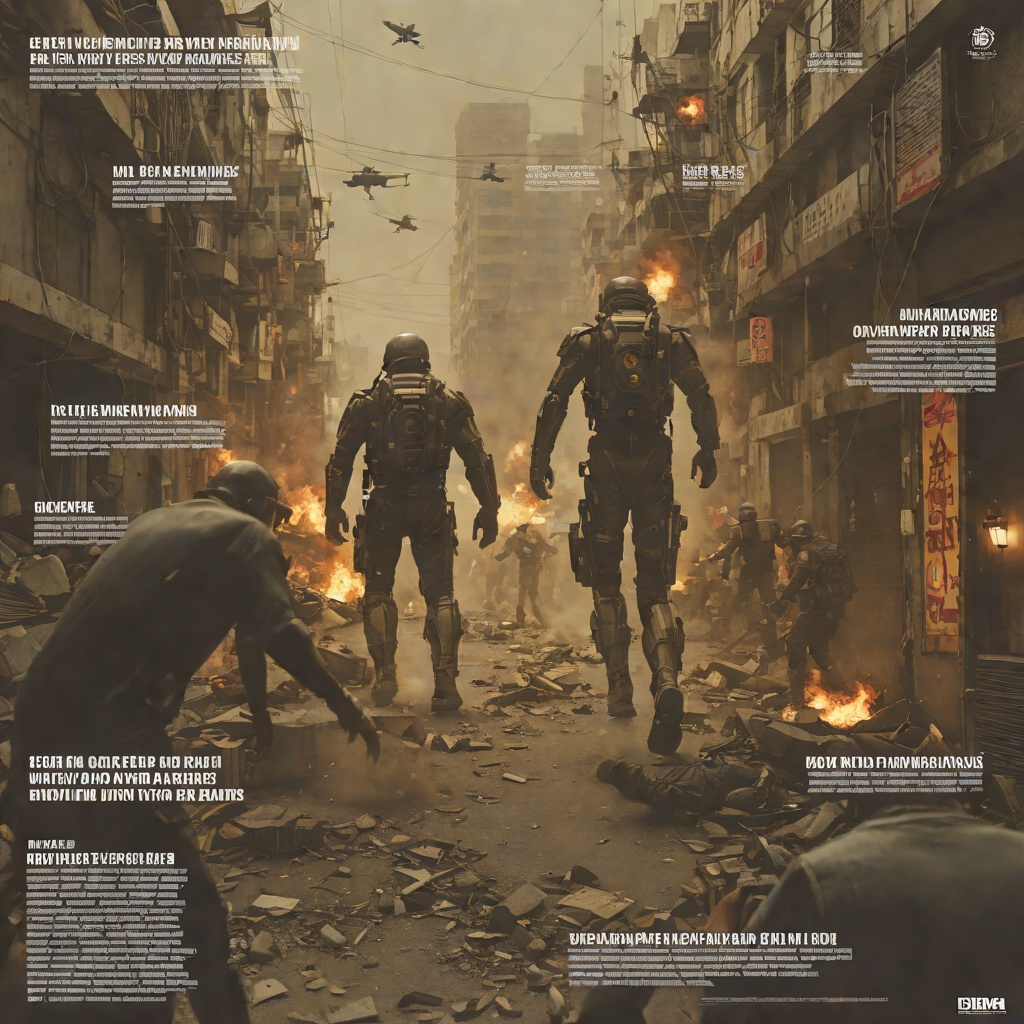
Poverty is spatially organized. Co-Op City lies south of the Canal in a radiating maze of parking lots, deserted shops, Urban Centers, and paved playgrounds, where cycle gangs have replaced effective public law. The district’s streets are ghostly and dangerous; residents who go out take a pneumo bus or carry a gas cylinder. The abandoned 2013 Humber stripped even to its wheel bearings and motor mounts, the wet garbage, broken windows, and graffiti make the district look less like a neighborhood than a neglected battlefield. Public authority remains present in slogans about the intrepid Block Police of South City, but absent in the daily environment that produces insecurity.
The boundary at the Canal is also an economic boundary. South of it, Free-Vee is free but employment is scarce; across it, the dream machine runs twenty-four hours a day on New Dollars available only to employed people. Ben crosses the Canal on foot, leaving behind the rat-infested district and entering a cleaner, policed city where his clothing, haircut, and sunken eyes immediately identify him as having only one acceptable purpose: the Games. The Network Games Building rises one hundred stories into cloud and smog, an emblem of the institution that turns the poor man’s deprivation into profitable entertainment.
The same class geography reappears at Voigt Airfield. Spectators divide themselves unconsciously along the road: middle- and upper-class citizens face the marina and country club, while poor people stand on the opposite side. The distinction is not only clothing or appearance but bodily condition. The poor are described through burst veins, sagging bodies, cold sores, pimples, and blank mouths, whereas the more prosperous crowd appears incomplete in another way, lacking the desperation produced by hunger and failed hope. The airfield thus stages poverty as a public spectacle before the confrontation with the tank, the police, the electrified cyclone fence, and the Lockheed/G-A Superbird.
Pollution, Abandonment, and Slow Harm
Poverty is also environmental. In Bradley Throckmorton’s circle, pollution is studied through library books on impurity counts, smog levels, and nose filters. Rich and Dink Moran build a pollution counter from coffee cans and parts taken from cars, hiding it in an alley. The homemade instrument recalls an earlier period when pollution was measured on a scale from one to twenty and factories had to close when the reading reached twelve, before the Revised Congress rolled the law back in 1987. Such details connect poor communities to harms that accumulate gradually and are then treated as ordinary background conditions.
The abandoned Super Pine Tree Mall makes that environmental history visible. Construction stopped at least two years earlier, leaving miles of half-built stores, rusted steel, discarded pipe, cinderblock, boards, shacks, and Quonset huts overtaken by scrub, blackberry, blackthorn, and blue spruce. Foundation holes resemble graves, while industrial waste in a nearby river produces a sulphurous stench. The site is both failed development and refuge: an economic project abandoned by capital becomes a rat warren through which people in flight must move. Its physical decay gives poverty a landscape, showing how the poor inherit the residue of projects that promised growth but left danger behind.
Poverty as Social Control
The city’s treatment of the poor combines neglect with surveillance. In the wealthier districts, police stand on corners, guards use electric move-alongs, and officers watch Ben for loitering or possible arrest as he approaches the Games Building. In Co-Op City, by contrast, public order has largely receded, leaving residents to gangs, improvised protection, and hazardous transit. The unequal distribution of policing means that poverty is alternately abandoned and criminalized: the poor are left unsafe in their own streets and treated as suspicious when they enter prosperous ones.
This structure also governs language. Ben is repeatedly ordered to move along, told there is no job, and threatened with violence while searching for work. The command reduces a person without employment to a nuisance to be displaced. At the same time, the television and Games institutions absorb the resulting desperation, offering money, visibility, and family assistance only through a contest whose central mechanism is pursuit. Poverty therefore supplies both the population and the dramatic energy of the spectacle. It creates the crisis, restricts the alternatives, and then allows the Network to market survival as entertainment.
Poverty’s decisive significance lies in this transformation of deprivation into a system of choices that are formally open but materially forced. The Richards family needs medicine, food, and money; Ben lacks transport and employment; polluted and segregated spaces determine where he can live and how he can move; and the Games place a monetary value on every hour he remains alive. The condition is consequently personal in its suffering but structural in its production, binding intimate family decisions to urban planning, labor policy, medical inequality, environmental neglect, and commercial spectacle.